
Despite being one of the most well-known terms in the English language, the history and development of the word “church” are frequently forgotten. This term, which is essential to Christianity, has a complicated and rich past that combines religious, cultural, and linguistic strands. This essay will investigate the origins of the term “church,” look at its diverse interpretations, and analyze how its importance has changed over time.
Origin of the word “Church”
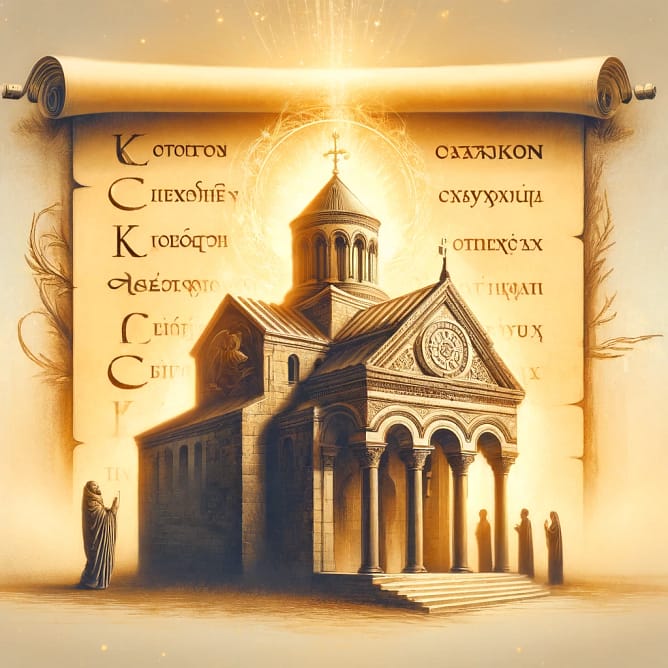
The fact that the English word “church” has roots in multiple ancient languages illustrates how cross-cultural interactions have influenced it. The Greek term “kyriakón” (κυριακόν), which means “of the Lord” (derived from “kyrios,” meaning “lord” or “master”), is where its journey starts. The house of the Lord or the Christian place of worship was referred to by this term in early Christian contexts.
The word “ecclesia,” which was used to refer to both the Christian congregation and the structure where they met, originated in Greek and entered Late Latin. It’s interesting to note that the word “ecclesia” itself is derived from the Greek “ekklesia,” which means “assembly” or “gathering.” This word was used to describe political assemblies in classical Greece before Christianity.
The West Germanic version of the Late Greek word “kyriakón” is where the Old English word “cirice” or “circe” originated. This change demonstrates how language changed as Christianity expanded throughout Europe. In Middle English, “church” eventually evolved from “cirice,” to become the word we use today.
Earlier Use by Christians
In the early days of Christianity, the term “church” referred mainly to the body of believers rather than just a physical building. Early Christians used the Greek word “ekklesia” to refer to their gatherings, highlighting the social and relational facets of their faith. The early Christian church, which considered itself as a continuation of the assembly of Israel, summoned by God, was fundamentally shaped by this sense of community.
In contrast, the term “kyriakón” started to be used more often as Christianity became more established. It distinguished these hallowed locations from other kinds of meetings by explicitly referring to the structures where Christians assembled for worship
Growth During the Middle Ages
The idea of the “church” grew and evolved throughout the Middle Ages. In Europe, the Church—which was capitalized to represent the institution—became a powerful social and political force. The word “church” came to refer to the greater hierarchical and administrative structure of the Christian faith in addition to the local congregation and its physical space.
The actual church buildings, which served as hubs for social interaction, education, and worship, became essential to community life. Church architecture changed over time, reflecting the church’s increasing wealth and power by becoming grander and more ornate. With their lofty spires and elaborate stained glass, the Gothic cathedrals across Europe remain iconic reminders of this historical era.
Reformation and Current Applicability

The meaning and application of the word “church” were profoundly altered during the Protestant Reformation in the sixteenth century. Reformers such as John Calvin and Martin Luther emphasized a return to the biblical definition of “ekklesia,” which is the assembly of believers. They promoted a closer, more intimate relationship with God while criticizing the institutionalized excesses and corruption of the Roman Catholic Church.
As a result, rather than emphasizing the institutional hierarchy or the physical building, many Protestant denominations returned their attention to the community of believers. Protestant churches, in contrast to their Catholic counterparts, frequently adopted simpler, more austere styles as a result of this theological shift.
The word “church” still has two meanings in modern usage: it can refer to both the larger body of believers as well as the actual buildings where Christians gather to worship. The term is also used more broadly to describe various Christian denominations and their institutional structures, such as the Catholic Church, the Orthodox Church, and the numerous Protestant denominations.
Variations in Culture and Linguistics
The diverse ways that Christianity has been incorporated into societies around the world are reflected in the various meanings and applications that the word “church” and its synonyms have in different languages and cultural contexts.
Terms derived from “ecclesia” are more prevalent in Romance languages. For instance, the Latin word “ecclesia” is the source of the Spanish word “iglesia,” the French word “église,” and the Italian word “chiesa.” These words frequently highlight the congregational and communal facets of the church.
Terms that are associated with “kyriakón” are common in Germanic languages. The English word “church” shares a root with the German word “Kirche,” the Dutch word “kerk,” and the Scandinavian word “kyrka.” Both the institutional side of the church and the actual building may be implied by these terms.
Terms in Slavic languages are frequently derived from “sobor,” which means “council” or “assembly.” For instance, the terms “собор” (sobor) in Russian and “събор” (sabor) in Bulgarian highlight the assembly of believers and the communal aspect of the church.
The Church in Modern Society
The idea of the church is still evolving today as a result of shifting social and cultural norms. Virtual worship services and online churches are examples of the new church communities that have emerged as a result of the development of digital technology and the internet. Even in the digital age, the church remains relevant as a place for community and connection, as evidenced by these innovations.
Furthermore, arguments concerning the church’s place in society are frequently raised in modern talks about it. These discussions center on topics like social justice, inclusivity, and the church’s response to global issues. Many contemporary churches actively participate in advocacy, community service, and humanitarian endeavors in an effort to practically apply Jesus’ teachings.
Summary
The word “church” carries with it a rich tapestry of meanings and historical significance. From its Greek origins to its current application, it has expanded to include not only the actual locations where Christians congregate but also the larger body of believers. Knowing the beginnings and evolution of this term offers important insights into the history of Christianity and its continuing influence on society and culture.
Without a doubt, as time goes on, the church will continue to change and adapt, reflecting the dynamic nature of faith and the various ways that people look for connections to the divine and to one another. The term “church” has a long and illustrious history that keeps taking on surprising new turns.